August 8th, morning
Journey to Indian Island
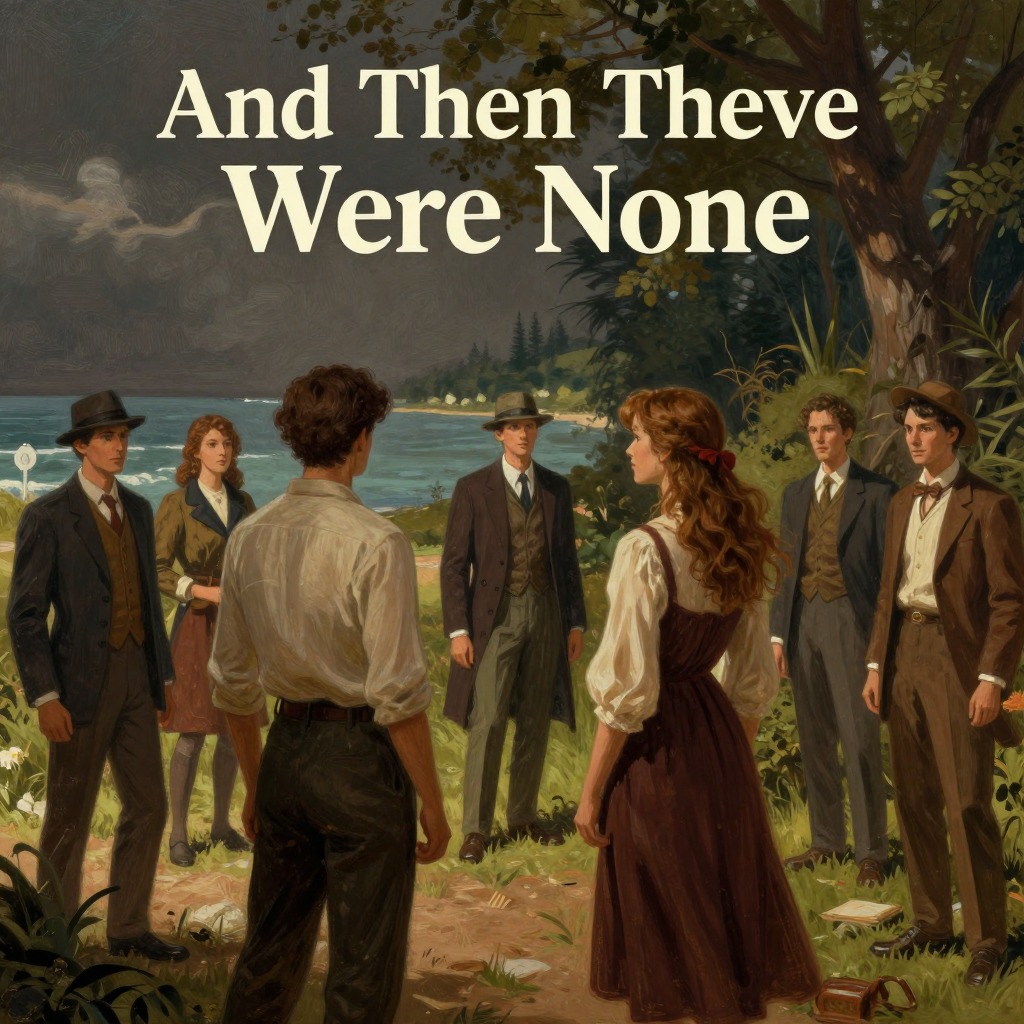
Eight strangers travel separately to the Devon coast, each lured by a letter or offer from a mysterious host named U.N. Owen. Among them are retired judge Lawrence John Wargrave, schoolteacher Vera Elizabeth Claythorne, adventurer Philip Lombard, spinster Emily Caroline Brent, General John Gordon Macarthur, physician Edward George Armstrong, wealthy playboy Anthony James Marston, and ex-detective William Henry Blore, who poses as a South African named Davis. Each passenger reflects on their past and the circumstances that brought them to this remote island, unaware that they are being assembled for a sinister purpose. The journey establishes the isolated setting and introduces the central mystery of the unknown host.
August 8th, late afternoon
Arrival on Indian Island
The guests gather at the village of Sticklehaven and are ferried by boatman Fred Narracott to Indian Island, a stark, rocky outcrop off the Devon coast. The island's modern house, built by American millionaire Elmer Robson, stands in stark contrast to the foreboding landscape. As they approach, the guests feel a growing unease, sensing something unnatural about the place. The group is met by the butler Thomas Rogers and his wife Ethel Rogers, who inform them that Mr. and Mrs. Owen are delayed and will not arrive until the next day. The guests settle into their luxurious but unsettling rooms, each decorated with a framed nursery rhyme about ten little Indian boys.
August 8th, evening
Dinner and the Gramophone Accusation
The eight guests and the Rogerses sit down to an elegant dinner, during which they notice ten small china figures of Indian boys on the table, matching the nursery rhyme in their rooms. After dinner, as they gather in the drawing-room, a disembodied voice suddenly booms through the room, accusing each person by name of a specific murder. The accusations range from the drowning of a child to the abandonment of men to die, from judicial murder to poisoning. The voice terrifies the group, and Mrs. Rogers faints. The source is discovered to be a gramophone record hidden in an adjoining room, set to play by Rogers on Owen's orders. The guests realize they have been lured to the island by a madman who knows their darkest secrets.
August 8th, late evening
Revelation of U.N. Owen
After the gramophone accusation, the guests compare their invitations and discover that each was tricked by a different pretext. The judge points out that the initials U.N. Owen stand for 'Unknown,' confirming that their host is a mysterious figure who has assembled them to face judgment for crimes the law could not punish. Blore admits he is an ex-detective hired to watch the others, and Lombard reveals he was paid to come. The group realizes they are trapped on the island with a dangerous lunatic who intends to execute them. The atmosphere shifts from confusion to fear as they understand the gravity of their situation.
August 8th, late evening
Death of Anthony Marston
As the guests discuss their predicament, Anthony James Marston, the young and reckless playboy, pours himself a drink from the sideboard. He chokes suddenly, turns purple, and collapses dead. Dr. Armstrong examines him and determines he was poisoned with potassium cyanide, which acted almost instantly. The others are shocked, as Marston seemed the least likely to commit suicide. The poison must have been in his glass, but the whiskey and soda are untouched. The death appears to be murder, but no one can explain how it was done. The first death fulfills the first line of the nursery rhyme: 'One choked his little self and then there were nine.'
August 9th, early morning
Death of Mrs. Rogers
The next morning, Rogers cannot wake his wife. Dr. Armstrong finds Ethel Rogers dead in her bed, apparently from an overdose of a sedative. The doctor had given her a mild sleeping draught the night before, but she received a fatal dose. The guests suspect Rogers may have killed her to silence her about their past crime, or that she died of fear and guilt. The death corresponds to the second line of the rhyme: 'One overslept himself and then there were eight.' The china figures on the dining table have decreased from ten to eight, confirming the pattern. Fear and suspicion begin to spread among the remaining guests.
August 9th, late morning
Death of General Macarthur
General John Gordon Macarthur, who had been sitting alone by the sea, is found dead, struck on the back of the head with a blunt instrument. Dr. Armstrong confirms it is murder. The General had seemed resigned to death, telling Vera that none of them would leave the island. His death follows the third line of the rhyme: 'One said he'd stay there and then there were seven.' The china figures now number seven. The guests realize the killer is among them, and the pattern of the nursery rhyme is being followed exactly. The group becomes increasingly paranoid and desperate.
August 9th, afternoon
Search of the Island
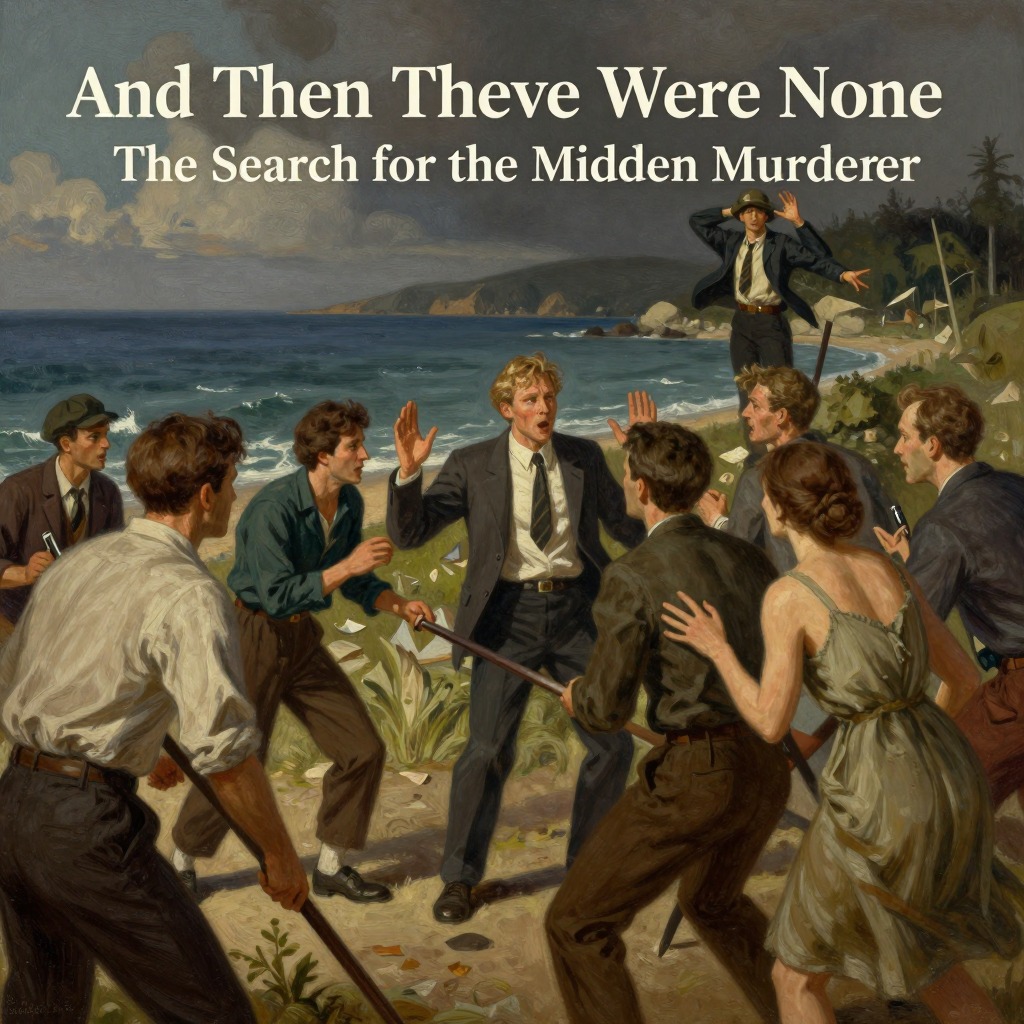
Lombard, Armstrong, and Blore search the island thoroughly, looking for any hiding place or sign of an intruder. They find no one, confirming that the murderer must be one of the guests. The search also reveals that the island is completely isolated; the motor boat has not arrived, and the weather is worsening. The three men discuss the possibility that the killer is using the nursery rhyme as a blueprint. They also note that the china figures are disappearing in sequence. The search heightens the tension, as the group realizes they are trapped with a killer who is methodically executing them.
August 10th, early morning
Death of Rogers
The next morning, Rogers is found dead in the wash-house, killed with a chopper while chopping sticks. The murder corresponds to the fourth line of the rhyme: 'One chopped himself in halves and then there were six.' The china figures on the table have decreased to six. The guests are now in a state of panic, realizing that the killer is following the nursery rhyme exactly. The murder of Rogers, who was the butler, suggests that the killer is methodical and ruthless. The remaining guests—Wargrave, Armstrong, Lombard, Blore, Vera, and Emily Brent—are now acutely aware that they are being picked off one by one.
August 10th, late morning
Death of Emily Brent
After breakfast, Emily Caroline Brent is found dead in the dining-room, killed by an injection of potassium cyanide. A hypodermic syringe is found outside the window, and a broken china figure lies beside it. The death corresponds to the fifth line of the rhyme: 'A bumblebee stung one and then there were five.' The killer has used a bee as a symbolic touch, as the rhyme mentions a bumblebee. The guests are horrified by the theatricality of the murder. The syringe belongs to Dr. Armstrong, who claims it was stolen. Suspicion falls on him, but no one can prove anything. The group is now reduced to five: Wargrave, Armstrong, Lombard, Blore, and Vera.
August 10th, afternoon
Search and Confiscation of Weapons
After Emily Brent's death, the remaining five guests agree to a thorough search of themselves and their rooms to confiscate any weapons or drugs. Lombard's revolver is missing, and Armstrong's syringe is gone. The group locks up all remaining drugs and divides the keys between Blore and Lombard. The search reveals that the killer has been able to move freely and hide evidence. The atmosphere is one of extreme tension and mutual suspicion. The guests are now trapped with a murderer who seems to be one step ahead of them at every turn.
August 10th, evening
Seaweed Scare
As darkness falls, Vera goes to her room and is terrified by a cold, clammy touch on her neck. She screams, and the others rush to her aid. They discover that a wet ribbon of seaweed has been hung from the ceiling, which brushed against her throat. The scare is a psychological attack, designed to unnerve the group. The incident corresponds to the sixth line of the rhyme: 'A red herring swallowed one and then there were three.' The seaweed is a red herring, a distraction. The guests realize the killer is playing with their minds, using the nursery rhyme as a script.
August 10th, evening
Death of Justice Wargrave
During the confusion of the seaweed scare, the guests discover that Lawrence John Wargrave is dead, apparently shot through the forehead. He is found in his chair, dressed in a scarlet robe and a wig made from grey wool and a red curtain, mimicking a judge's attire. The death corresponds to the seventh line of the rhyme: 'One got in Chancery and then there were four.' The revolver used is missing, and the guests are shocked by the theatrical staging. The group is now reduced to four: Armstrong, Lombard, Blore, and Vera. The killer seems to be closing in.
August 10th, night
Disappearance of Dr. Armstrong
In the middle of the night, Blore hears footsteps and sees a figure leaving the house. He wakes Lombard, and they discover that Dr. Armstrong is missing from his room. The two men search the island but find no trace of him. The china figures on the table have decreased to three, suggesting Armstrong is dead. The disappearance corresponds to the eighth line of the rhyme: 'A red herring swallowed one and then there were three.' The guests are now down to three: Lombard, Blore, and Vera. The mystery deepens as Armstrong's body is not found.
August 11th, afternoon
Death of Blore
The next day, the three remaining guests—Lombard, Blore, and Vera—stay together on the cliffs, trying to signal for help. Blore goes back to the house alone to get food and is killed by a heavy marble bear clock pushed from Vera's window. The death corresponds to the ninth line of the rhyme: 'A big bear hugged one and then there were two.' The marble bear clock, shaped like a bear, crushes Blore's skull. The murder is brutal and theatrical, following the nursery rhyme exactly. Vera and Lombard are now the only two left on the island.
August 11th, late afternoon
Death of Philip Lombard
Vera and Lombard find Dr. Armstrong's body washed up on the shore, confirming he drowned. Realizing that only she and Lombard remain, Vera understands that Lombard must be the killer. She pretends to help move the body, then picks Lombard's pocket and steals his revolver. When Lombard lunges at her, she shoots him dead. The death corresponds to the tenth line of the rhyme: 'One got frizzled up and then there was one.' Vera is now alone on the island, believing she has survived the ordeal. She feels a sense of relief and triumph.
August 11th, evening
Death of Vera Claythorne
Vera returns to the house, exhausted and euphoric. She enters her bedroom and finds a noose hanging from the ceiling, with a chair placed beneath it. Overcome by guilt and the psychological pressure of the nursery rhyme, she climbs onto the chair, puts the noose around her neck, and kicks the chair away, hanging herself. The death corresponds to the final line of the rhyme: 'He went and hanged himself and then there were none.' Vera's suicide is the last death, completing the pattern. The island is now silent, with ten dead bodies.
August 12th-13th
Discovery of Bodies by Police
After the storm subsides, a rescue party from the mainland reaches Indian Island. They find ten dead bodies, each corresponding to the nursery rhyme. The police are baffled by the mystery, as there is no sign of an outsider. The investigation reveals that the victims were all guilty of crimes that the law could not punish. The police find diaries and notes left by the victims, but the puzzle remains unsolved. The case becomes a famous unsolved mystery, with no explanation for how the murders were committed or who the killer was.
After the events
Confession of Lawrence Wargrave
A manuscript is found in a bottle washed ashore, written by Lawrence John Wargrave. In it, he confesses to being the mastermind behind the entire plot. He reveals that he is terminally ill and wanted to commit the perfect crime, executing those who had escaped justice. He describes how he faked his own death, manipulated the others, and killed them one by one according to the nursery rhyme. He explains how he used Armstrong as an unwitting accomplice, then drowned him. He staged his own suicide to appear as a victim. The confession solves the mystery, revealing that the judge was the killer all along.